
Best Computer Courses for Accounting Jobs in Hyderabad
Best Computer Courses for Accounting Jobs in Hyderabad If you are looking for an accounting job in Hyderabad, knowing basic computer skills is no longer
 Skip to content
Walk into any accounts department in India a neighbourhood textile shop in Surat, a fast-growing logistics startup in Pune, a busy CA firm in Delhi, or a mid-size pharma distributor in Hyderabad, and you will almost always find one common thread: TallyPrime running on at least one computer screen. This is not a coincidence. Tally commands more than 80 per cent of India’s accounting software market, serves over 2.5 million businesses, and is used across 100+ countries. In practical terms, this dominance means one thing for job seekers and career changers: tally training is the single most impactful short-course investment you can make if you want to land an accounting or finance job in India quickly.
This article answers, in full, the question that thousands of commerce students, B.Com graduates, working accountants, and CA aspirants search for every month: what are the career opportunities available after completing a tally course? We cover every job role, real salary figures, the industries that hire Tally-trained professionals, the skills you actually develop during tally training, the types of tally course available, freelancing paths, and how a tally certification gives a boost to CA, CMA, and MBA aspirants. If you are deciding whether to enrol in a tally course or advising someone who is this is the guide you need.
Accounting is the systematic process of recording financial transactions of a business. Every organization performs financial activities s
Before listing the specific job roles, it helps to understand why the career scope of a tally course is so wide in India specifically.
The Indian economy is built on small and medium enterprises. As of 28 February 2026, more than 7.83 crore enterprises have registered on the government’s Udyam Registration Portal and Udyam Assist Platform combined. The overwhelming majority of these businesses handle their daily accounting, GST return filing, inventory, payroll, and statutory compliance through TallyPrime — the flagship product from Bangalore-based Tally Solutions. This creates a structural, never-saturated demand for people who can operate the software competently.
At the same time, India’s GST framework makes Tally knowledge mandatory rather than optional for businesses. Every enterprise with a turnover above ₹40 lakh (₹20 lakh for service businesses) must file GSTR-1 and GSTR-3B returns every month or quarter. TallyPrime 5.0, launched in September 2024, introduced Connected GST — a feature that allows accountants to file returns directly from within the software without navigating to the GST portal separately. This kind of deep compliance integration means employers do not treat tally training as a bonus skill; they treat it as a baseline requirement, the same way employers in the 1990s required a typing certificate.
The result is visible on every major job board. LinkedIn India lists over 3,000 open Tally roles at any given time. Naukri carries thousands more. Internshala, which focuses on freshers and interns, lists 263+ active tally vacancies. Whether you are a student just finishing Class 12, a B.Com graduate looking for a first corporate job, or an experienced accountant wanting to formalise your skills, a tally course directly translates into hiring conversations — and that is a fairly rare guarantee in any certification market.
uch as purchasing goods, selling products, paying salaries, receiving payments from customers, and paying taxes to the government. All these transactions must be recorded accurately.
The main purpose of accounting is to maintain a clear record of all financial activities so that businesses can understand their financial position.
Accounting helps companies answer important questions such as:
Without proper accounting, businesses cannot track their financial performance. Students who join an Accounting course in Hyderabad usually start with the fundamentals such as bookkeeping, journal entries, ledgers, trial balance, profit and loss statements, and balance sheets.
These concepts form the foundation of financial management and are essential for anyone who wants to become an accountant.
There are more than fifteen distinct job roles open to Tally-certified professionals in India. They range from entry-level tally operator positions (ideal for freshers directly after a basic tally course) to senior finance and consulting roles for professionals with 5–10 years of experience. Here is a structured breakdown.
The tally operator role is typically the first job a fresher lands after completing a basic tally course. The work involves entering sales vouchers, purchase vouchers, receipts, and payments into TallyPrime on a daily basis, maintaining ledger accuracy, and generating basic reports for the business owner or senior accountant.
Fresher salary range: ₹1.2 lakh to ₹1.8 lakh per year in Tier-2 cities; ₹1.8 lakh to ₹2.4 lakh in metros like Mumbai, Delhi, and Bengaluru. Experienced tally operators (3–5 years) can earn ₹2.5 lakh to ₹3.5 lakh annually. The role is heavily available across manufacturing units, wholesale distributors, retail stores, and small service businesses. LinkedIn alone shows consistent tally operator openings from companies in Ahmedabad, Chennai, Kolkata, Lucknow, and Jaipur throughout the year.
This role sits just above tally operator and requires a broader understanding of accounting principles along with hands-on tally training. Accounts assistants handle bank reconciliations, maintain debtors and creditors ledgers, assist with GST data preparation, and support the preparation of trial balance and basic financial statements.
Salary range: ₹15,000 to ₹25,000 per month for freshers in metro cities (Apna.co salary data, 2026). With 3–5 years of experience, accounts assistants regularly earn ₹3.5 lakh to ₹5 lakh per year. This role is the most common first placement from Tally Authorised Partner training centres and private tally course institutes across India.
Completing an advanced tally course one that covers GST, TDS, inventory, and payroll, makes you directly eligible for accountant positions without any prior work experience, provided you also have a commerce graduation (B.Com, BBA, M.Com, or equivalent).
Accountants manage the full books of a business: recording all transactions, reconciling bank accounts, preparing profit & loss statements and balance sheets, filing GST returns, depositing TDS, and submitting statutory reports. This is the backbone of every MSME accounting function in India.
Salary range: ₹18,791 per month (India average, Indeed.in, 2026) for general accountant roles. Senior accountants with 5+ years of tally experience earn ₹5 lakh to ₹10 lakh annually at mid-size companies. The national average on AmbitionBox places accountant pay at around ₹2.5 lakh for freshers.
The accounts executive title typically implies at least 1–3 years of experience and ownership of a complete accounts function within a department. Accounts executives manage vendor payments, customer collections, credit control, GST return filing, TDS computation and deposit, monthly closing entries, and MIS report preparation for management.
Salary range: Average ₹6.1 lakh per year (Glassdoor India, May 2026, across 7,285 self-reported salaries), ranging from ₹3.28 lakh at the lower end to ₹17.75 lakh for senior accounts executives at larger corporates. Accounts executive is one of the most-advertised positions on Naukri for tally training-certified candidates in 2025–2026.
After completing a tally course with a strong GST module, many professionals transition into GST consulting — handling return filing, ITC reconciliation, GST notices, and compliance advisory for multiple small business clients simultaneously.
This role has grown dramatically since GST was introduced in India in 2017. Businesses need someone who understands both the law and how to operate it inside TallyPrime — filing GSTR-1, GSTR-3B, GSTR-9, managing e-invoices, generating e-way bills, and reconciling GSTR-2A/2B mismatches. TallyPrime 5.0’s Connected GST has made this workflow faster, but it still requires a trained hand.
Salary / freelance earnings: Employed GST executives earn ₹3–₹4 lakh per year at entry level, rising to ₹6–₹10 lakh with experience (IIM SKILLS salary data). Freelance GST consultants with 10–50 business clients charge ₹500 to ₹3,000 per GSTR-3B filing, with top earners reporting ₹25,000 to ₹50,000 per month from their client portfolio.
A tax consultant advises businesses and individuals on income tax planning, TDS compliance, GST strategy, advance tax, and tax audit support. After completing an advanced tally course and building practical experience across a few filing seasons, tally-trained professionals frequently move into tax consulting roles — especially those working in or alongside CA firms.
Salary range: ₹5.36 lakh total compensation for those with under one year of experience (PayScale India, 2026); ₹6.64 lakh average for 1–4 years of experience. Senior tax consultants at corporate finance teams and boutique advisory firms earn ₹8–₹15 lakh per year.
TallyPrime’s payroll module handles the full payroll lifecycle: employee master creation, salary structure definition, attendance processing, statutory deductions (PF, ESI, Professional Tax, LWF), payslip generation, Form 16 production, and TDS on salary returns. Businesses — particularly those with 30–500 employees — frequently hire dedicated payroll executives who know Tally’s payroll module inside out.
Salary range: Average ₹3.65 lakh per year (Glassdoor India). Freshers in Tier-2 cities earn ₹2.8–₹3.5 lakh; experienced payroll executives with 5+ years cross ₹6.5–₹10 lakh per year.
If you are pursuing CA, CMA, or have a strong accounting background and want exposure to audit and compliance work, tally training opens doors at Chartered Accountant firms. Audit assistants use TallyPrime daily for audit trail verification, statutory compliance checks, stock audit data extraction, and working paper preparation.
ICAI’s ICITSS (Integrated Course on Information Technology and Soft Skills) — mandatory before CA articleship — covers Tally fundamentals, but firms consistently favour articleship candidates who arrive with a deeper tally course certificate. A TallyEssential or TallyProfessional certification from Tally Education Pvt. Ltd. (TEPL) directly improves stipend negotiation in CA firms.
Salary / stipend: ₹10,000–₹25,000 per month for article assistants and junior audit staff (Indeed India, 2026). Audit executives with 3–5 years of tally experience earn ₹4–₹7 lakh per year.
The Tally Authorised Partner (TAP) network consists of 28,000+ business partners across India who sell TallyPrime licences, implement the software at client sites, customise it through TDL (Tally Definition Language), and provide training and annual maintenance. TAPs regularly hire Tally Implementation Executives and ERP Support Executives who combine tally training with client-facing skills.
Salary range: ₹3–₹6 lakh per year at entry to mid level. Experienced Tally implementation professionals who can also write TDL customisations earn significantly more — typically ₹6–₹12 lakh. This career path can also lead to becoming an independent Tally Authorised Partner yourself.
Billing executives use TallyPrime’s invoicing and sales-order modules to create GST-compliant sales invoices, debit notes, credit notes, and delivery challans. This role is common in retail chains, distribution houses, hospitals, hotels, and service companies. The work is highly structured and a good starting point for those finishing a basic tally course.
Salary range: ₹12,000–₹22,000 per month for freshers; ₹25,000–₹35,000 for experienced billing supervisors.
TallyPrime’s inventory management module is used by manufacturers, pharmaceutical distributors, automotive spare-parts dealers, FMCG distributors, and retail chains to manage stock groups, godowns, batch tracking, expiry dates, reorder levels, bill of materials (BOM), and manufacturing journals. Professionals with strong tally training in inventory management are specifically recruited for stock accountant and inventory control roles.
Salary range: ₹2–₹3.5 lakh for freshers; ₹5–₹8 lakh for experienced inventory managers at distribution-heavy companies in FMCG, pharma, and manufacturing.
Bookkeeping is the systematic recording of daily financial transactions — and TallyPrime is the standard tool used for bookkeeping across Indian businesses. In-house bookkeepers work within a single organisation; outsourced bookkeepers serve multiple clients, often through KPO (Knowledge Process Outsourcing) firms that handle accounting for UK, US, Australian, and Middle East SMEs.
Salary range: ₹2–₹3.5 lakh for entry-level in-house bookkeepers; ₹3.5–₹7 lakh for experienced bookkeepers in KPO firms with cross-software skills (TallyPrime + QuickBooks + Xero). KPO-based roles in cities like Pune, Ahmedabad, and Indore frequently advertise Tally proficiency alongside UK/US GAAP knowledge.
With 5+ years of experience and additional qualifications (M.Com, MBA Finance, CA Inter), tally-trained professionals routinely grow into finance executive and finance manager roles. Finance executives handle MIS reporting, budget preparation, variance analysis, working capital management, and periodic board reporting — all of which leverage TallyPrime’s cost centre, budget, and multi-currency modules.
Salary range: Finance executives earn ₹5–₹12 lakh annually. Finance managers average ₹9.93 lakh per year nationally (upGrad salary data), with experienced finance managers at MSMEs and mid-corporates earning ₹12–₹20 lakh. Tally is listed as a required or preferred skill in the vast majority of MSME-sector finance manager job descriptions.
Experienced tally professionals who enjoy teaching can build rewarding careers as Tally trainers. Tally Authorised Training Centres, private institutes (Aptech, NIIT, ICA Edu Skills, JBK Academy), and independent coaching academies hire tally faculty on a full-time and part-time basis. With experience, Tally trainers also develop online courses for Udemy, create YouTube tutorial channels, and earn content royalties.
Salary / earnings: Full-time tally trainers earn ₹1.5–₹3.6 lakh per year at entry level; experienced trainers with strong placement records and online presence earn ₹8–₹15 lakh. Top YouTube-based Tally educators with 100,000+ subscribers earn substantially more through ads, sponsorships, and course sales.
A tally certification on its own does not directly place you in a financial analyst role. However, it is a strong foundation. B.Com or M.Com graduates who start as accountants with tally training, then add Advanced Excel and Power BI skills, are well-positioned to transition into financial analyst roles within 5–7 years. Financial analysts handle forecasting, ratio analysis, investment evaluation, and management reporting.
Salary range: ₹5–₹12 lakh per year, depending on the sector and seniority. Financial analyst roles in BFSI, IT, and listed manufacturing companies command the highest pay.
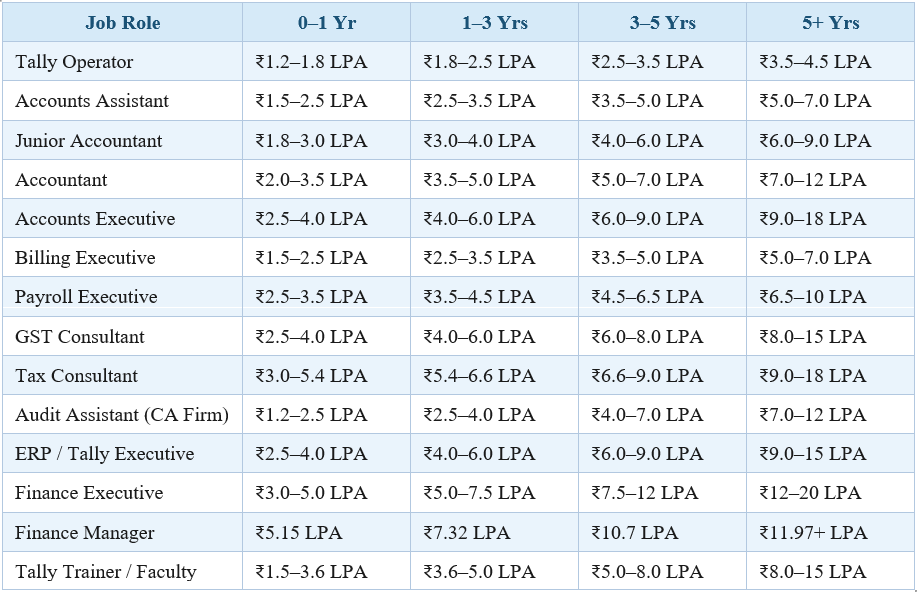
Sources: PayScale India, Glassdoor India, AmbitionBox, Indeed India, Naukri.com, Apna, JobHuntDaily, Internshala (2025–2026). LPA = Lakhs Per Annum. Figures are approximate ranges; actual offers vary by city, employer size, and candidate qualification.
Understanding what a tally course actually teaches helps you see why the career scope is so wide. A well-structured tally training programme whether at JBK Academy or a Tally Education Pvt. Ltd. authorised centre builds skills across four core areas.
You start with double-entry accounting fundamentals: debits and credits, journal entries, ledger posting, trial balance, profit & loss account, and balance sheet. TallyPrime is the vehicle, but the conceptual knowledge transfers to any accounting environment. By the end of a tally course, you can read a company’s books, identify errors, and prepare periodic financial statements independently.
This is the skill that makes tally training especially valuable in post-2017 India. A tally course covers the full GST workflow: creating GST-enabled ledgers, applying the correct HSN/SAC codes, generating GSTR-1, filing GSTR-3B, preparing annual GSTR-9, reconciling input tax credit against GSTR-2A/2B, handling e-invoicing, and generating e-way bills. TallyPrime 5.0’s Connected GST module which allows direct API-based filing without leaving the software — is now part of the standard tally training curriculum at updated institutes.
Advanced tally training covers TDS at source: deducting TDS on vendor payments, rent, professional fees, and salary; depositing challans; filing 26Q and 24Q quarterly returns; and generating Form 16/16A for deductees. The payroll module covers employee masters, salary structures, PF (Provident Fund), ESI (Employee State Insurance), Professional Tax, and Leave With Wages calculations — skills that make you valuable to any HR-cum-accounts team.
The inventory module in TallyPrime is more capable than most students realise when they begin a tally course. It handles multi-godown stock tracking, batch and expiry date management, bill of materials for manufacturing, job-work (with job-worker GST implications), stock valuation methods (FIFO, LIFO, Average), and purchase order to goods-received note workflows. Professionals with strong tally training in inventory management are particularly sought after in pharma distribution, FMCG wholesale, and manufacturing.
TallyPrime’s reporting engine generates receivables ageing, payables ageing, stock ageing, ratio analysis, fund flow, cash flow, budget variance, and cost centre reports. Learning to configure and extract these reports during tally training gives you the data literacy that CFOs and business owners value when they look for someone to manage their numbers rather than merely enter them.
One of the most important things to understand about the career scope after a tally course is the breadth of industries involved. Unlike many specialised certifications that apply to one or two sectors, tally training is cross-industry. Any business that operates in India and is registered under GST needs someone who can handle its books on TallyPrime.
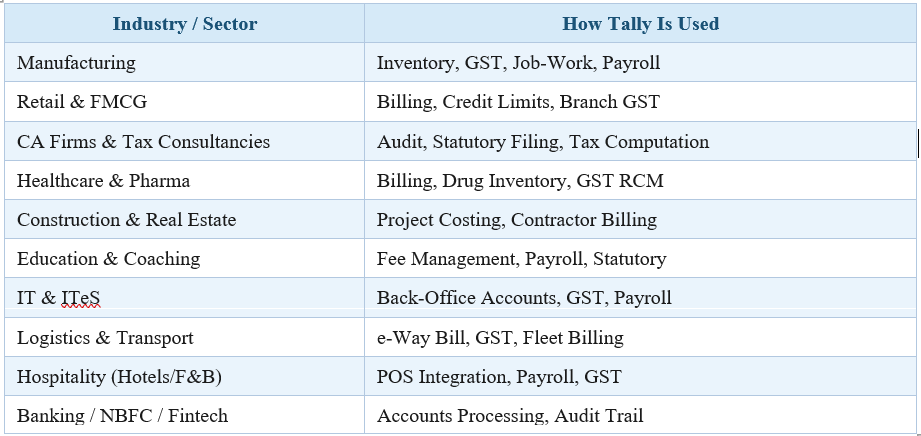
India accounts for approximately 63.69% of all global Tally ERP customers (6sense industry data). Manufacturing, retail, and real estate represent the three largest sectoral user bases.
Manufacturing hubs like Pune, Chennai, Coimbatore, Ahmedabad, and Ludhiana generate high volumes of tally job vacancies because manufacturers need Tally for inventory, GST on raw materials and finished goods, job-work accounting, and payroll for large workforces. CA firms across all major cities are the single largest employer of freshers straight out of a tally course they need tally operators and audit assistants constantly, especially around filing deadlines.
The healthcare and pharma distribution sector deserves specific mention. Pharmaceutical distributors handle complex inventory with batch tracking, expiry dates, and GST at different rates — all managed through TallyPrime’s inventory and GST modules. Tally-trained professionals with pharmaceutical distribution knowledge are highly sought after in cities like Mumbai, Ahmedabad, Vadodara, Indore, and Hyderabad.
Not all tally training programmes are the same. Choosing the right type of tally course for your career goal matters significantly.
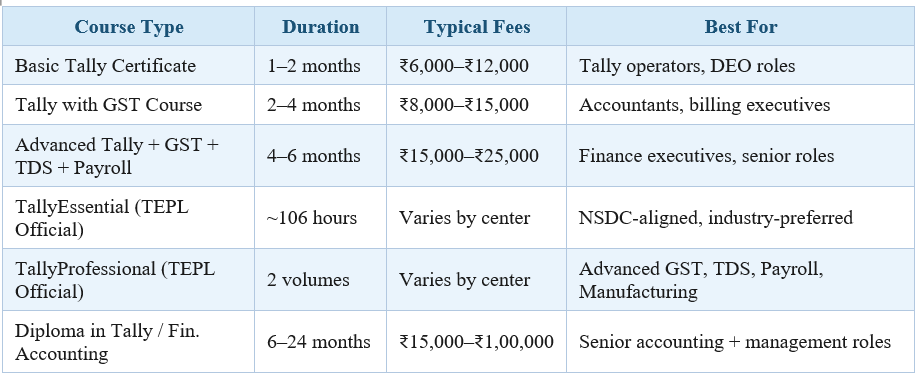
The official tally certification pathway is administered by Tally Education Pvt. Ltd. (TEPL), the educational division of Tally Solutions Pvt. Ltd. These certifications are considered the gold standard in the Indian job market because they are directly linked to the Tally Job Portal, where employers post vacancies specifically for TEPL-certified candidates.
TallyEssential is divided into three levels totalling approximately 106 hours of instruction. Level 1 covers recording and reporting; Level 2 covers accounts payable, accounts receivable, and inventory; Level 3 covers GST, TDS, and compliance. TallyProfessional, available in two volumes, advances into multi-currency, manufacturing, advanced GST, TCS, payroll with income tax computation, and audit-trail management. Importantly, TEPL states on its website that TallyProfessional content is aligned with the NSDC (National Skill Development Corporation) Qualification Pack — which means it is accepted in government skill-development schemes and PSU empanelments.
Employers have increasingly moved to TallyPrime from the older Tally.ERP 9 platform since 2021. Candidates trained only on Tally.ERP 9 face a growing disadvantage at interviews. More importantly, TallyPrime 5.0’s Connected GST launched September 2024 — has changed how GST filing workflows operate. A tally training programme that does not teach Connected GST, e-invoice generation, and GSTR-2B reconciliation inside TallyPrime 5.x is already outdated.
When choosing a tally course, confirm explicitly with the institute that it teaches TallyPrime release 5.0 or later, and that the Connected GST module, e-invoicing, and audit trail features are part of the curriculum.
TallyEssential is divided into three levels totalling approximately 106 hours of instruction. Level 1 covers recording and reporting; Level 2 covers accounts payable, accounts receivable, and inventory; Level 3 covers GST, TDS, and compliance. TallyProfessional, available in two volumes, advances into multi-currency, manufacturing, advanced GST, TCS, payroll with income tax computation, and audit-trail management. Importantly, TEPL states on its website that TallyProfessional content is aligned with the NSDC (National Skill Development Corporation) Qualification Pack — which means it is accepted in government skill-development schemes and PSU empanelments.
With over 7.83 crore registered enterprises in India as of early 2026, the private sector demand for tally training is effectively unlimited. Small businesses in every district of India from Shillong to Coimbatore, from Rajkot to Bhubaneswar run on TallyPrime and regularly need to fill junior and mid-level accounting positions. This geographic distribution means that completing a tally course in a Tier-2 or Tier-3 city is just as valuable as it is in a metro, because local MSMEs hire locally.
National job portals support the scale of this demand. LinkedIn India consistently shows 3,000+ open Tally roles; BeBee aggregates 1,736+ India listings; Internshala lists 263+ active tally vacancies for freshers and interns. These are simultaneously active openings, not historical aggregates.
For candidates interested in government employment, tally certification functions as a supporting credential rather than a primary qualifier. Here is where it applies:
This section covers what many students do not hear about when they enrol in a tally course: tally training can be the foundation of an independent income — no job offer required.
A tally-trained professional with solid GST and TDS knowledge can serve 5–15 small business clients in their local area, charging ₹2,000–₹10,000 per client per month for monthly bookkeeping, GST return filing, TDS return filing, and bank reconciliation. A solo practitioner managing 10 clients can realistically earn ₹50,000–₹1,00,000 per month with extremely low overhead — just a laptop, an internet connection, and a TallyPrime single-user licence.
Dedicated GST consultants who handle GSTR-1, GSTR-3B, GSTR-9, ITC reconciliation, and notice replies for 10–50 business clients are in steady demand across India. Fees range from ₹500 to ₹3,000 per GSTR-3B filing per client per month, depending on transaction volume. India’s complex multi-rate GST structure means small business owners genuinely need outside help, and a tally-trained GST specialist fills that need.
Indian tally-trained accountants are increasingly hired by UK, US, Australian, and Middle East SMEs for remote bookkeeping through platforms like Upwork, Freelancer.in, and Truelancer. Hourly rates start at ₹500 and reach ₹2,000 for India-based Tally specialists; professionals who cross-train in QuickBooks, Xero, or Zoho Books earn ₹1,500–₹4,000 per hour for international clients.
The most ambitious self-employment path is becoming a Tally Authorised Partner (TAP). TAPs sell TallyPrime licences (Silver licence at ₹22,500 + GST per year; Gold at ₹67,500 + GST per year), implement the software at client sites, customise it via TDL (Tally Definition Language), and provide ongoing annual maintenance contracts. The TAP network exceeded 28,000 partners across India by 2025–2026. A small TAP practice in a Tier-2 city typically generates ₹3–₹10 lakh net in the first two years, with strong recurring revenue from annual maintenance renewals thereafter.
Tally training is not just for people whose final goal is an accounting job. For professional course aspirants, it serves a complementary sometimes essential practical function.
The Institute of Chartered Accountants of India mandates ICITSS (Integrated Course on Information Technology and Soft Skills) before articleship commences. This course includes a Tally module. However, the ICITSS coverage is introductory. CA firms in Mumbai, Delhi, Bengaluru, Chennai, Hyderabad, Kolkata, Pune, and Ahmedabad assign articles to GST filing, stock audits, statutory audits, and tax computations — all of which run through TallyPrime. An article who arrives with a deeper TallyEssential or TallyProfessional certification gets more substantive work assigned earlier and can negotiate a higher stipend.
For CA aspirants who are between attempts or taking longer to clear finals, tally training provides an immediate earning path. Junior accountant and GST consultant roles at ₹3–₹5 lakh per year are accessible while the professional journey continues, removing financial pressure.
Cost and Management Accountancy course content — including manufacturing costing, job-work accounting, standard costing, and budgetary control — maps directly onto TallyPrime’s manufacturing journals, job-costing module, BOM management, and budget modules. CMA candidates who practise these concepts inside TallyPrime develop a practical fluency that is noticeable in interviews for manufacturing sector finance roles.
A bachelor’s or master’s degree in commerce, or an MBA in finance, provides strong theoretical accounting knowledge but limited software proficiency. Completing a tally course, particularly one that covers TallyPrime 5.x, GST, TDS, and payroll, bridges this gap and makes a fresh graduate employment-ready on day one. Final-year B.Com students at Delhi University, Mumbai University, Calcutta University, and most state universities routinely add a 2–3-month tally course to their CVs specifically for this reason.
Three forces in India’s regulatory and economic environment make tally training disproportionately powerful as an employment accelerator.
Every Indian business above the GST turnover threshold must file GSTR-1 and GSTR-3B returns. With over 7.83 crore registered enterprises, the aggregate volume of filings is enormous. TallyPrime is the dominant filing tool, and Connected GST in TallyPrime 5.0 has made it even more central to the workflow. Businesses cannot avoid hiring someone who can manage this process.
Effective from FY 2023-24, all companies registered under the Companies Act 2013 must use accounting software with an immutable audit trail. TallyPrime meets this requirement. Companies are upgrading from Tally.ERP 9 to TallyPrime specifically because of this mandate, and they are hiring TallyPrime-trained accountants as part of that upgrade cycle.
With 7.83 crore enterprises registered across India and the vast majority running on TallyPrime, demand for tally-trained professionals exists in every district of the country not just in the metro cities. This geographic distribution makes tally training equally valuable for a student in Nagpur, Bhopal, Patna, or Visakhapatnam as it is for someone in Mumbai or Delhi.
Target roles: Tally Operator, Accounts Assistant, Billing Executive, Junior Accountant.
What to focus on: Master TallyPrime’s day-to-day voucher entry, bank reconciliation, and basic GST filing. Add Advanced Excel alongside your tally course — the Tally + Excel combination is the minimum standard for entry-level roles in 2025–2026.
Expected pay: ₹12,000–₹25,000 per month in Tier-2 cities; ₹18,000–₹30,000 in metros.
Target roles: Accountant, Accounts Executive, GST Consultant, Tax Consultant, Payroll Executive.
What to focus on: Complete TallyEssential Level 3 or TallyProfessional certification from TEPL. Specialise in GST filing, TDS returns, and payroll processing. The salary jump from generalist accountant (₹2.5 lakh) to GST-specialist accountant (₹4.5–₹6 lakh) is the single largest step-change in the tally career path.
Expected pay: ₹3.5–₹9 lakh per year, depending on specialisation and city.
Target roles: Senior Accountant, Accounts Manager, Finance Executive, Finance Manager, ERP Consultant.
What to focus on: Layer tally expertise onto a professional qualification (M.Com, MBA Finance, CA Inter, or CMA). Develop TDL customisation skills if you want to move into ERP consulting. Begin freelancing on the side to build a client base — this is the most natural transition point to full self-employment.
Expected pay: ₹7–₹20 lakh per year in employment; ₹50,000–₹2,00,000 per month for established freelance practices.
A basic tally course covering TallyPrime 5.x, GST filing, and bank reconciliation is sufficient to secure junior tally operator and accounts assistant roles. For accountant positions at mid-size companies, adding GST and TDS modules — ideally through TallyEssential Level 3 — is strongly recommended. Pair it with Advanced Excel and the combination is enough for most entry-level finance roles without a degree.
Freshers in Tier-2 cities earn approximately ₹12,000–₹20,000 per month for tally operator and junior accountant roles. In metro cities like Mumbai, Delhi, and Bengaluru, fresher salaries typically range from ₹18,000–₹28,000 per month. With a focused GST specialisation added to your tally training, fresher salaries can start as high as ₹25,000–₹35,000 per month at CA firms and compliance-focused businesses.
For entry-level positions, TallyEssential Levels 1 and 2 are sufficient. For accountant, GST consultant, and payroll executive roles, completing TallyEssential Level 3 (Taxation and Compliance) or progressing to TallyProfessional significantly improves job prospects and salary negotiation. TallyProfessional is the NSDC-aligned certification, making it acceptable for government and PSU-adjacent positions as well.
Yes and freelancing is one of the most rewarding outcomes of tally training for self-motivated individuals. With solid GST, TDS, and bookkeeping skills, you can manage 5–15 small business clients independently, earning ₹50,000–₹1,00,000 per month from a home office. The Tally Authorised Partner route offers additional income through licence sales and implementation work.
Highly useful. ICAI’s ICITSS covers Tally fundamentals before articleship, but CA firms expect article assistants to work fluently in TallyPrime on real filing and audit tasks from day one. A TallyEssential or TallyProfessional certificate makes the transition into articleship smoother, allows more substantive work to be assigned earlier, and provides an earning safety net during the CA preparation period.
A Class 12 commerce student who completes a 2–4 month tally course with GST is immediately eligible for tally operator, billing executive, and accounts assistant roles — without waiting for degree completion. This is particularly relevant for students who want to start earning during their graduation years. JBK Academy’s tally training programme, for example, is specifically designed to make Class 12 and first-year B.Com students job-ready before graduation.
JBK Academy (jbkacademy.in) offers comprehensive tally training designed around the practical demands of India’s 2025–2026 accounting job market. The curriculum covers TallyPrime 5.x with Connected GST, e-invoicing, audit trail management, GST return filing, TDS, payroll, and advanced inventory all the skills that show up on actual job descriptions, not a generalised course outline.
Every tally course at JBK Academy is updated to reflect the latest TallyPrime release, ensuring that students learn what employers ask for in interviews today not what was relevant three years ago. Placement support, interview preparation, and career guidance are built into the programme, so completing your tally training at JBK Academy is not just about the certificate; it is about converting that training into an actual career opportunity as fast as possible.
Whether you are a Class 12 student looking for your first accounting job, a B.Com graduate who wants to add practical software skills to your degree, an existing accountant moving from Tally.ERP 9 to TallyPrime, or a professional building a freelance bookkeeping practice JBK Academy’s tally course is structured to take you from zero to employment-ready.
The career opportunities available after completing a tally course in India are broader, better paid, and more geographically distributed than most students expect when they first consider the training. From tally operator positions that serve as a launchpad to experienced finance manager roles that pay ₹10–₹20 lakh per year, tally training creates a genuine, direct path through India’s MSME-driven economy.
What makes tally training particularly powerful in 2025–2026 is the regulatory environment. GST compliance is non-negotiable for registered businesses. The MCA’s audit trail mandate has pushed companies onto TallyPrime. And India’s 7.83 crore registered enterprises create a demand for tally-skilled professionals that exists in every city, town, and industrial cluster across the country — not just in the metros.
A tally course is not the end destination it is the starting point. Add GST specialisation, TDS knowledge, and Advanced Excel, and the earning potential accelerates sharply. Add a professional qualification or entrepreneurial ambition, and the path leads all the way to a finance manager role, an independent GST consultancy, or a Tally Authorised Partner business.
If you are serious about building an accounting career in India, tally training is the highest-ROI investment you can make in the next three to six months. JBK Academy’s tally course is where that journey starts with updated curriculum, placement support, and a programme built around what employers actually need in 2025–2026.
Bussa Karthik Reddy is an experienced corporate trainer in Hyderabad, an entrepreneur, and a digital marketing expert with over 10 years of industry experience. He focuses on professional training in Primavera P6, Microsoft Project, and BIM training. He helps students and professionals build strong careers in project management and construction technologies.
He founded Onclick Digital Marketing Services, JBK Academy, and Raster FX Studios. At these organizations, he provides job-oriented training in Hyderabad that emphasizes real-world skills, job placement support, and career growth. His skills also include lead generation through digital marketing, SEO strategies, and performance marketing. This makes him a well-rounded trainer in both technical and marketing fields.
As a Digital Marketing Trainer in Hyderabad and HR Manager at MAAC Kukatpally, he has hands-on experience with student placement, recruitment, and career development. This dual role helps him understand what the industry needs and train students with practical skills that are relevant to the job market.
With a strong passion for teaching, he has trained hundreds of students in BIM, project management, and digital marketing in Hyderabad. He aims to help learners gain in-demand skills, improve their job prospects, and secure high-paying positions in competitive industries.
Disclaimer: Salary figures are compiled from publicly available job market data sources (PayScale India, Glassdoor India, AmbitionBox, Indeed India, Naukri.com) and represent approximate ranges for guidance purposes. Actual compensation depends on city, employer size, candidate qualifications, and negotiation. Tally Solutions, TallyPrime, TallyEssential, and TallyProfessional are trademarks of Tally Solutions Pvt. Ltd. JBK Academy is an independent tally training institute.
Best Computer Courses for Accounting Jobs in Hyderabad If you are looking for an accounting job in Hyderabad, knowing basic computer skills is no longer
Photoshop Course in Hyderabad: Beginner Roadmap for Design and Marketing Photoshop is one of the most widely recognized tools in the creative industry. From social
YouTube Video Editing Course: Skills Needed for Content Creators Creating videos for YouTube is no longer only about recording good footage. Successful creators need to
Video Editing Course in Hyderabad: Skills, Software and Career Opportunities Video has become one of the most powerful forms of digital communication. From YouTube videos
Graphic Designing Course in Hyderabad: Tools, Portfolio and Career Scope Choosing the right graphic designing course in Hyderabad can be an important first step for
Digital Marketing Course in Hyderabad: SEO, Google Ads and Social Media Career Path Choosing the right Digital Marketing course in Hyderabad can be an important
Tally vs Advanced Excel vs SAP FICO vs Power BI: Which Course Should You Choose? Choosing between Tally, Advanced Excel, SAP FICO, and Power BI
Accounting Course for Career Gap Candidates and Homemakers: Restart Roadmap Returning to work after a career break can feel challenging, especially when technology, workplace expectations,
MS Office Course in Ameerpet: Basic Computer Skills for Office Jobs In today’s workplace, basic computer knowledge is no longer an optional skill. Whether you
ITR and GST Tax Practitioner Course: How to Start a Tax Filing Career Taxation is an essential part of every business and financial system. Individuals
SAP FICO After Tally: Best Learning Path for Accountants For students and accounting professionals planning to build a career in finance, learning Tally first and
Zoho Books Course in Hyderabad: Cloud Accounting Skills for Freshers The shift from traditional accounting to cloud-based financial management has created new opportunities for students,
Advanced Excel and Tally Course: Best Skill Combination for Accounting Jobs Accounting has evolved significantly over the past decade. Businesses no longer rely solely on
Best Accounting Courses After 12th or Graduation in Hyderabad Start Your Career with the Best Accounting Course in Hyderabad Choosing the right career after completing
Tally Prime with GST Course: Complete Practical Syllabus for Beginners Accounting is one of the most stable and in-demand career fields in today’s business world.
Power BI Course for Accounting and Finance Students: Dashboard Skills Roadmap Introduction to Power BI Overview of Power BI and its capabilities. Installation and setup
SAP FICO Course in Ameerpet Hyderabad: Syllabus, Eligibility and Jobs Finance departments are rapidly adopting enterprise resource planning systems to manage accounting, taxation, cost control,
GST and ITR Filing Course in Hyderabad: Who Can Learn and Career Scope Tax compliance is an essential part of every business, professional practice and
Advanced Excel Course in Ameerpet: Skills, Syllabus, and Career Benefits Advanced Excel is one of the most useful job skills for students, freshers, accountants, office
Accounting Course After B.Com: Best Learning Path for Freshers in Hyderabad The best accounting course after BCom teaches practical accounting, TallyPrime, GST, TDS, income-tax procedures,