#conversiontracking

Accounting Course After B.Com: Best Learning Path for Freshers in Hyderabad

Accounting Course After B.Com: Best Learning Path for Freshers in Hyderabad
The best accounting course after BCom teaches practical accounting, TallyPrime, GST, TDS, income-tax procedures, Advanced Excel, payroll, cloud accounting software, and basic ERP finance skills. A B.Com degree provides students with a strong understanding of accounting principles, business law, taxation, economics, and finance. However, many fresh graduates still find it difficult to handle practical accounting work because they have limited experience with the software and processes used in companies.

The right learning path is:
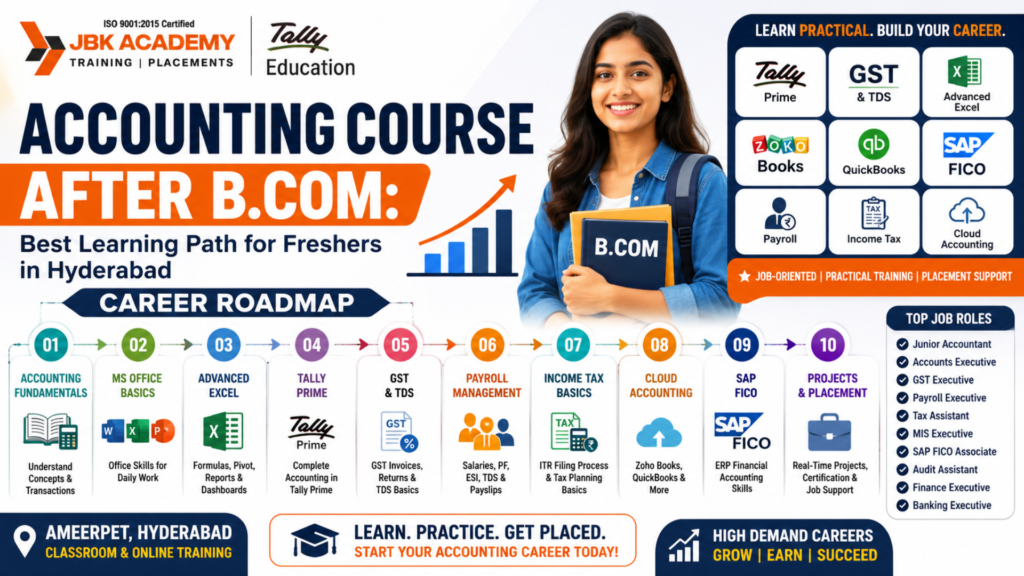
Accounting Fundamentals → MS Office → Advanced Excel → Tally Prime → GST and TDS → Payroll → Income Tax → Cloud Accounting → SAP FICO → Practical Projects → Certification → Placement Preparation

Students looking for a complete, structured option can explore the Advanced Diploma in Accounting – 7 Months offered by JBK Academy. The program is designed to cover office automation, spreadsheets, computerised accounting, cloud accounting, ERP finance and practical tax-filing procedures.

Why Is an Additional Accounting Course Needed After B.Com?

B.Com students study important subjects such as:

  • Financial accounting
  • Corporate accounting
  • Cost accounting
  • Income tax
  • Business law
  • Auditing
  • Economics
  • Banking
  • Financial management
  • Business statistics

These subjects provide the theoretical foundation required for an accounting career.

However, employers usually expect freshers to perform practical tasks such as:

  • Creating company accounts
  • Recording sales and purchase transactions
  • Passing journal entries
  • Managing ledgers
  • Reconciling bank statements
  • Preparing GST invoices
  • Calculating GST and TDS
  • Managing payroll
  • Creating Excel reports
  • Preparing profit and loss statements
  • Tracking outstanding payments
  • Working with accounting or ERP software

A B.Com graduate may understand the meaning of a balance sheet but may not know how to prepare one using Tally Prime or Excel.

Similarly, a student may know GST concepts but may not have experience creating GST invoices, recording input tax credit, reviewing reports, or assisting with returns.
A job-oriented accounting course fills this gap by converting academic concepts into workplace skills.

Is Accounting a Good Career After B.Com?

Yes. Accounting is one of the most relevant career options after B.Com because students already have a foundation in commerce, finance, taxation and business operations.

Accounting professionals are required in:
  • Chartered accountant offices
  • Tax-consulting firms
  • Retail companies
  • Manufacturing organisations
  • Educational institutions
  • Hospitals
  • Logistics companies
  • Construction businesses
  • Banking and financial services
  • E-commerce companies
  • Software companies
  • Small and medium enterprises
  • Corporate finance departments


Almost every organisation needs professionals who can record financial transactions, manage invoices, monitor expenses, process salaries, prepare reports and support statutory compliance. However, a degree alone may not be sufficient. Freshers who can demonstrate practical software skills and accounting projects are generally better prepared for entry-level opportunities.

Best Accounting Learning Roadmap After B.Com

Here is a step-by-step roadmap for freshers who want to build a career in accounting.
 

Step 1: Strengthen Practical Accounting Fundamentals

Students should first revise the accounting concepts they studied during B.Com.
Important topics include:
  • Types of accounts
  • Golden rules of accounting
  • Journal entries
  • Ledger posting
  • Trial balance
  • Trading account
  • Profit and Loss Account
  • Balance sheet
  • Bank reconciliation
  • Depreciation
  • Outstanding expenses
  • Prepaid expenses
  • Accrued income
  • Bad debts
  • Provisions
  • Inventory valuation
  • Rectification of errors


The objective should not be to memorise entries. Students should understand how every business transaction affects accounts.
 
For example, when a company purchases goods on credit, the student should know:
 
  • Which accounts are affected
  • Whether they are debited or credited
  • How the transaction affects inventory
  • How the supplier balance is created
  • How the payment is recorded later
  • How the transaction appears in reports


This understanding becomes essential when working with accounting software.
 

Step 2: Learn MS Office for Daily Office Work

Accounting professionals regularly use Microsoft Office applications.
Students should learn:
 

Microsoft Word

  • Business letters
  • Invoice formats
  • Formal reports
  • Tables
  • Mail merge
  • Page formatting
  • Documentation


Microsoft Excel

  • Data entry
  • Basic formulas
  • Sorting and filtering
  • Tables
  • Formatting
  • Charts
  • Print settings
  • Basic reports


Microsoft PowerPoint

  • Business presentations
  • Financial summaries
  • Monthly-report presentations
  • Data visualisation


Email and Office Communication

  • Writing professional emails
  • Sharing reports
  • Managing attachments
  • Following naming conventions
  • Maintaining organised folders


These skills may appear basic, but they are important for working efficiently in an office environment.
 

Step 3: Master Advanced Excel for Accounting and MIS

Advanced Excel is one of the most valuable tools for B.Com graduates.
Companies use Excel for:
  • Sales reports
  • Purchase reports
  • Expense tracking
  • Salary calculations
  • Bank reconciliation
  • Inventory reports
  • Customer outstanding reports
  • Vendor payments
  • Budgeting
  • Management Information System reports
  • Financial analysis
  • Dashboard preparation


Important Excel topics include:
  • IF and nested IF
  • SUMIF and SUMIFS
  • COUNTIF and COUNTIFS
  • VLOOKUP
  • XLOOKUP
  • INDEX and MATCH
  • Text functions
  • Date and time functions
  • Conditional formatting
  • Data validation
  • Pivot tables
  • Pivot charts
  • Lookup and reference functions
  • Power Query
  • Data cleaning
  • Dashboard creation
  • Basic macros


Advanced Excel training should be practical.
Students should not only learn formulas individually. They should apply them to complete accounting situations such as salary sheets, sales registers, ageing reports and monthly MIS dashboards.
 

Step 4: Learn Tally Prime with Practical Accounting

Tally Prime is an important accounting application for freshers seeking roles in small businesses, accounting firms, retail companies, service organisations and finance departments.
Students should learn:
 
  • Company creation
  • Ledger creation
  • Group creation
  • Voucher entry
  • Contra vouchers
  • Payment vouchers
  • Receipt vouchers
  • Journal vouchers
  • Purchase entries
  • Sales entries
  • Debit notes
  • Credit notes
  • Inventory creation
  • Stock groups
  • Units of measurement
  • Godowns
  • Bank reconciliation
  • Cost centres
  • Budgets
  • Payroll
  • Financial statements
  • Data backup and restoration
  • Security controls
  • Report generation


JBK Academy’s Tally-related course information emphasises practical learning in accounting, taxation, payroll, inventory and financial reporting.
A useful Tally project should simulate the complete accounting cycle of a business rather than include only a few basic entries.

Step 5: Learn GST Practically

GST knowledge is important for many accounting jobs in India.
 
Students should understand:
  • GST registration basics
  • Types of GST
  • CGST, SGST and IGST
  • Intra-state and interstate transactions
  • HSN and SAC codes
  • Tax invoices
  • Input tax credit
  • Output tax
  • Reverse-charge basics
  • GST purchase entries
  • GST sales entries
  • Debit and credit notes
  • GST reports
  • GSTR-1 concepts
  • GSTR-3B concepts
  • E-way bill basics
  • E-invoicing basics
  • Reconciliation concepts


The student should be able to record transactions correctly in accounting software and verify whether the tax treatment is appropriate.
The aim is not just to understand GST definitions. It is to learn how GST affects actual purchases, sales, expenses and accounting reports.
 

Step 6: Learn TDS and Basic Taxation

TDS is another common responsibility in accounting roles.
 
Students should learn:
  • Meaning of TDS
  • Common payment categories
  • Deductor and deductee concepts
  • PAN-related requirements
  • TDS calculation
  • TDS accounting entries
  • Challan concepts
  • TDS return basics
  • Form 16 and Form 16A concepts
  • Reconciliation
  • Basic compliance workflow


B.Com freshers should also understand basic income-tax concepts such as:
  • Financial year and assessment year
  • Income categories
  • Deductions
  • Taxable income
  • Form 16
  • Individual return concepts
  • Advance tax basics
  • Self-assessment tax
  • Income-tax filing workflow


Tax laws and filing procedures can change, so students should learn through updated examples and current compliance practices.
 

Step 7: Learn Payroll Accounting

Payroll is a useful specialisation for accounting and HR-support roles.
 
Students should practise:
  • Employee-master creation
  • Salary structures
  • Basic salary
  • House Rent Allowance
  • Conveyance allowance
  • Special allowance
  • Overtime
  • Incentives
  • Provident Fund basics
  • Employee State Insurance basics
  • Professional tax
  • TDS on salary
  • Leave deductions
  • Bonus
  • Gratuity basics
  • Payslip preparation
  • Payroll journal entries
  • Salary reports


A complete payroll project should include employee attendance, gross salary, deductions, net salary, payslips and accounting entries.
 

Step 8: Learn Cloud-Based Accounting Software

Modern businesses increasingly use cloud-based accounting applications because they allow teams to access financial data, create invoices and monitor transactions online.
 
Useful platforms can include:
  • Zoho Books
  • QuickBooks
  • Wings
  • Other cloud accounting solutions
Students should learn:
  • Organisation setup
  • Customer and vendor creation
  • Invoice generation
  • Purchase recording
  • Expense management
  • Bank feeds
  • Payment tracking
  • Tax configuration
  • Reports
  • User access
  • Data export
  • Basic automation


JBK Academy’s Wings Accounting course highlights bookkeeping, GST, taxation, financial reporting, and practical use of accounting software.
Cloud accounting skills can be especially useful for freshers targeting start-ups, service businesses and modern accounting firms.
 

Step 9: Learn SAP FICO for Corporate Accounting

B.Com graduates interested in corporate finance and ERP-based accounting can consider SAP FICO after mastering accounting fundamentals.
SAP FICO includes two primary areas:
  • Financial Accounting
  • Controlling
Important topics can include:
  • Organisational structure
  • Company code
  • Chart of accounts
  • General ledger
  • Accounts payable
  • Accounts receivable
  • Asset accounting
  • Bank accounting
  • Cost centres
  • Internal orders
  • Financial statements
  • Closing activities
  • Integration concepts
JBK Academy’s SAP FICO course covers general ledger, accounts payable, accounts receivable, asset accounting, cost centres, internal orders and profitability-related concepts.
 
SAP should not be treated as a replacement for accounting fundamentals.
Students who understand journal entries, ledgers, taxation and financial statements usually find SAP finance processes easier to understand.
 

Step 10: Complete Real-Time Accounting Projects

Projects help freshers demonstrate their ability to apply their knowledge.
A strong accounting portfolio should include practical business scenarios.
 

Project 1: Complete Accounts of a Trading Business

Create accounts for a sample trading company.
Include:
  • Opening balances
  • Capital introduction
  • Purchases
  • Sales
  • Purchase returns
  • Sales returns
  • Expenses
  • Bank transactions
  • GST entries
  • Customer receipts
  • Vendor payments
  • Closing stock
  • Profit and Loss Account
  • Balance sheet


Project 2: GST Accounting Project

Create a GST-based business case containing:
  • Local purchases
  • Interstate purchases
  • Local sales
  • Interstate sales
  • Input tax credit
  • Output tax
  • Debit notes
  • Credit notes
  • GST reports
  • Tax reconciliation


Project 3: Payroll Project

Prepare payroll for a sample company with 20 employees.
Include:
  • Attendance
  • Salary structures
  • Allowances
  • PF
  • ESI
  • Professional tax
  • TDS
  • Payslips
  • Salary payment entries
  • Monthly payroll report


Project 4: Advanced Excel MIS Dashboard

Create a dashboard containing:
  • Monthly sales
  • Expenses
  • Profit
  • Regional performance
  • Product performance
  • Outstanding receivables
  • Vendor dues
  • Key financial indicators


Project 5: Bank-Reconciliation Project

Compare the company’s cash book with a bank statement.
Identify:
  • Unpresented cheques
  • Deposits not credited
  • Bank charges
  • Direct deposits
  • Interest entries
  • Incorrect entries
Prepare a final reconciliation statement.
 

Project 6: Cloud Accounting Project

Use a cloud accounting application to create:
  • Customers
  • Vendors
  • Products
  • Sales invoices
  • Purchase bills
  • Receipts
  • Payments
  • Expenses
  • GST reports
  • Profitability reports

Best Accounting Course Options After B.Com

The right course depends on the student’s existing knowledge, available time and career goal.
 

Short-Term Tally and GST Course

Suitable for students who want to begin applying for junior accounting roles quickly.
It can cover:
  • Accounting basics
  • Tally Prime
  • Inventory
  • GST
  • TDS
  • Payroll
  • Reports


Advanced Excel and MIS Course

Suitable for students targeting:
  • MIS Executive Roles
  • Reporting positions
  • Finance support
  • Operations roles
  • Data-management work


GST and Income-Tax Filing Course

Suitable for students interested in:
  • Tax-assistant roles
  • CA offices
  • GST-support work
  • Compliance assistance
  • Freelance tax services


SAP FICO Course

Suitable for graduates who have good accounting knowledge and want to explore ERP-finance or corporate-accounting roles.

Advanced Diploma in Accounting

A comprehensive diploma is suitable for students who want a complete, job-oriented learning path rather than taking separate courses one by one. The Advanced Diploma in Accounting – 7 Months at JBK Academy is presented as a structured professional program covering office automation, Advanced Excel, computerised accounting, cloud platforms, ERP finance systems, GST and income-tax procedures.

Which Accounting Course Should a B.Com Fresher Choose?

A fresher should select a course based on career goals.
Junior AccountantAccounting, Tally Prime, GST and Excel
Accounts ExecutiveTally, GST, TDS, payroll and Advanced Excel
Tax AssistantGST, TDS, income tax and accounting software
MIS ExecutiveAdvanced Excel, dashboards and reporting
Payroll ExecutiveExcel, payroll, PF, ESI, TDS and accounting
SAP FICO FresherAccounting fundamentals, Excel and SAP FICO
Audit AssistantAccounting, Excel, GST, taxation and documentation
Cloud AccountantZoho Books, QuickBooks, GST and Excel
Finance ExecutiveAccounting, Excel, taxation and financial reporting
Unsure students can begin with accounting, Tally, GST and Advanced Excel. These skills create a strong foundation for several entry-level roles.

Job Roles After Completing an Accounting Course

After completing a practical accounting course, freshers may apply for roles such as:
  • Junior Accountant
  • Accounts Assistant
  • Accounts Executive
  • Billing Executive
  • Tally Operator
  • GST Assistant
  • Tax Assistant
  • Audit Assistant
  • Payroll Executive
  • MIS Executive
  • Finance Executive
  • Accounts Payable Executive
  • Accounts Receivable Executive
  • Inventory Accountant
  • Back-Office Executive
  • Banking Operations Executive
  • SAP FICO Trainee
  • Cloud Accounting Executive
Job eligibility depends on the student’s qualification, practical knowledge, communication skills, software proficiency and interview performance.

How to Build an Accounting Portfolio

An accounting portfolio can help a fresher demonstrate practical knowledge.
It can contain:
  1. Sample company accounts
  2. Journal and ledger entries
  3. GST sales and purchase registers
  4. Bank reconciliation statement
  5. Payroll sheet
  6. Payslip format
  7. Excel MIS dashboard
  8. Customer ageing report
  9. Vendor-outstanding report
  10. Profit and loss statement
  11. Balance sheet
  12. Tax-calculation samples
  13. Cloud-accounting screenshots
  14. Project explanations
Do not include confidential financial data from a real company without permission.
Use fictional business names and sample transactions for training projects.

Frequently Asked Questions

Which accounting course is best after B.Com?

A comprehensive course covering practical accounting, Tally Prime, GST, TDS, Advanced Excel, payroll, taxation and accounting projects is a strong option for most B.Com freshers.
Students targeting corporate ERP roles can add SAP FICO after building a solid accounting foundation.
 

Can I get an accounting job after B.Com?

Yes. B.Com graduates can apply for junior roles in accounting and finance. Practical skills in Tally, GST, Excel, taxation, and reporting can improve their job-readiness.
 

Is Tally enough to get a job after B.Com?

Tally is useful, but learning Tally alone may limit opportunities. A better combination is:
Accounting + Tally Prime + GST + TDS + Advanced Excel + Payroll + Projects
 

Is Advanced Excel important for accountants?

Yes. Accountants use Excel for reconciliations, salary sheets, sales reports, outstanding reports, data analysis, financial calculations and MIS reporting.
 

Should a B.Com fresher learn SAP FICO?

A B.Com fresher can learn SAP FICO, but it is better first to understand practical accounting, financial statements, taxation, and Excel.
 

Which is better after B.Com: Tally or SAP FICO?

Tally is suitable for building practical accounting skills and preparing for entry-level positions in small and medium organisations.
SAP FICO is better suited to students interested in ERP-based corporate finance roles. They serve different career paths and can also be learned sequentially.
 

How long does it take to learn practical accounting?

The duration depends on the syllabus. A short course may take one or two months, while a comprehensive diploma covering multiple applications and taxation areas may take several months.
 

Can non-commerce students learn accounting?

Yes. Non-commerce students can learn accounting, but they may need additional time to understand debit, credit, journal entries, ledgers and financial statements.
 

What jobs can I apply for after an accounting course?

Students can apply for roles such as Junior Accountant, Accounts Assistant, Billing Executive, GST Assistant, Payroll Executive, MIS Executive, Audit Assistant and Accounts Executive.
 

Is an accounting certificate enough to get a job?

A certificate supports the resume, but employers also assess practical ability, accounting knowledge, accuracy, software proficiency and communication skills.
 

What projects should an accounting fresher complete?

Useful projects include complete company accounts, GST accounting, payroll processing, bank reconciliation, Excel MIS reporting, and cloud accounting exercises.
 

Is classroom or online accounting training better?

Both can be effective. Classroom training provides direct interaction and lab access, while online training offers location flexibility. The quality of practical sessions and trainer support is more important than the mode alone.

Why Choose JBK Academy for Accounting and Tally Training

Choosing the right training institute plays an important role in building a successful career. JBK Academy is known for providing professional accounting and software training for students who want to work in the finance field. Students receive practical training, industry-oriented curriculum, and guidance from experienced trainers. The institute focuses on real-time training so that students understand how accounting works in actual business environments. Because of this approach, JBK Academy has become a trusted Accounting training institute in Hyderabad and Tally training institute in Hyderabad for students who want to build careers in accounting.
Final Accounting Career Roadmap After B.Com

The recommended learning sequence is:
Accounting Fundamentals
MS Office and Basic Excel
Advanced Excel
Tally Prime
GST and TDS
Payroll
Income-Tax Basics
Cloud Accounting
SAP FICO
Real-Time Projects
Certification and Portfolio
Resume, Interview and Placement Preparation

B.Com students already possess a valuable academic foundation. The next step is to develop the practical tools required by businesses and accounting departments.

A good accounting course after BCom should help students move beyond theory and confidently handle transactions, taxation, payroll, reconciliations, financial reports and accounting software.

Start Your Accounting Career with JBK Academy Hyderabad

JBK Academy offers accounting, finance and job-oriented software courses for students, freshers and working professionals in Ameerpet, Hyderabad.

Students can explore training options in:
  • Practical accounting
  • Tally Prime
  • GST and TDS
  • Income-tax procedures
  • Advanced Excel
  • Payroll
  • Zoho Books
  • QuickBooks
  • Wings Accounting
  • SAP FICO
  • Office automation
  • Financial reporting

Explore the complete Advanced Diploma in Accounting – 7 Months for a structured learning path covering modern accounting applications, taxation and practical office skills. Visit JBK Academy Hyderabad to check available courses, training modes, batch details, certification, and placement support information.