Best Computer Courses for Accounting Jobs in Hyderabad
Best Computer Courses for Accounting Jobs in Hyderabad If you are looking for an accounting job in Hyderabad, knowing basic computer skills is no longer
 Skip to content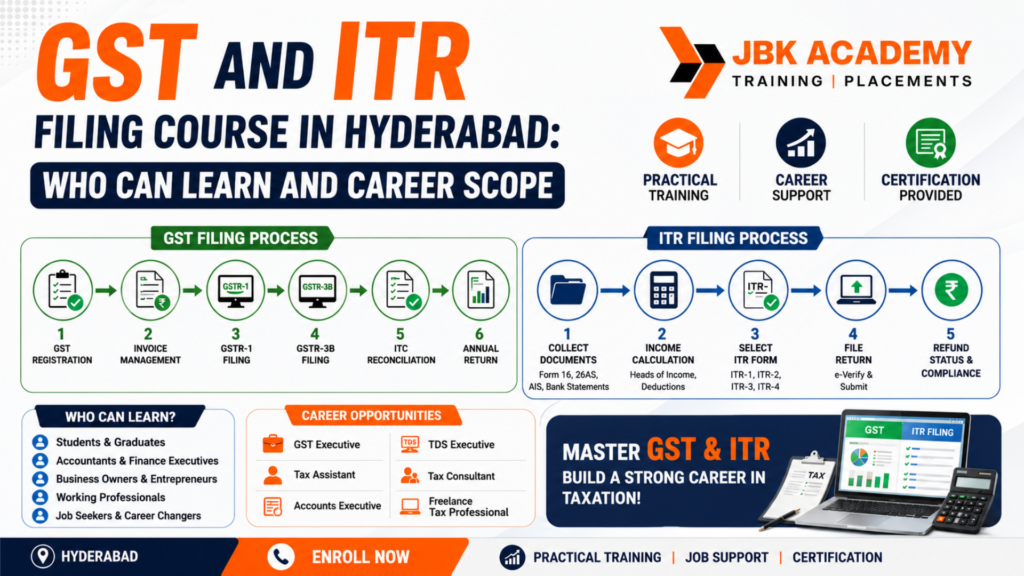
Tax compliance is an essential part of every business, professional practice and individual financial system. Companies must maintain invoices, reconcile transactions, file GST returns and meet applicable payment deadlines. Individuals, professionals and business owners may also need assistance with income-tax computation and Income Tax Return filing. This creates a continuing need for people who understand both GST compliance and ITR filing procedures. A GST and ITR filing course in Hyderabad is suitable for students, graduates, accountants, business owners, working professionals and beginners who want practical taxation skills. A commerce background can be helpful, but it is not compulsory when the course starts with accounting and taxation fundamentals. The course can prepare learners for entry-level roles in accounting offices, CA firms, tax consultancies and company finance departments. It can also help working accountants improve their compliance skills and help business owners understand their own tax responsibilities.
Students, graduates, accountants, working professionals, entrepreneurs and even non-commerce beginners can learn a GST and ITR filing course.
The most important requirements are an interest in taxation, basic computer knowledge and a willingness to practise calculations, documentation and online filing procedures.
1. B.Com and M.Com Students
Commerce students are among the most suitable candidates because subjects such as accounting, business law, economics and taxation are often part of their academic background.
However, college education may remain largely theoretical. Practical taxation training helps students understand how actual compliance work is completed using invoices, statements, government portals and return forms.
A GST and ITR course can help commerce students connect concepts such as turnover, purchases, sales, deductions and taxable income with real filing procedures.
2. BBA and MBA Graduates
Management students who want to work in finance, accounts, taxation or business operations can also learn GST and ITR filing.
The course can be particularly useful for candidates specialising in:
Understanding tax compliance can help management graduates communicate more effectively with accounts departments, auditors, tax consultants and business owners.
3. CA, CMA and CS Students
Professional-course students can use practical GST and ITR training to strengthen their filing knowledge.
Their academic programmes may provide deeper legal and theoretical understanding, while a practical course can offer additional exposure to:
The course does not replace a professional qualification, but it can improve the learner’s ability to perform entry-level compliance work under appropriate supervision.
4. Accountants and Accounts Executives
Working accountants frequently handle sales entries, purchase entries, bank transactions, TDS information, payroll details and supporting financial documents.
Learning GST and ITR filing can help them move beyond routine bookkeeping and participate in compliance activities such as:
This combination of accounting and taxation can improve their relevance to small businesses, accounting firms and finance departments.
5. Fresh Graduates Looking for Accounting Jobs
Fresh graduates often face difficulty because employers expect practical knowledge in addition to academic qualifications.
A job-oriented GST course in Ameerpet can help learners practise tasks that commonly arise in accounting and tax-support roles.
These may include:
Practical familiarity can make it easier for graduates to understand interview questions and workplace assignments.
6. Working Professionals
Professionals already working in accounts, finance, payroll, administration or banking can use an income tax course in Hyderabad to upgrade their skills.
The course may help them move towards roles involving:
Flexible weekday, weekend or online batches may be useful for professionals who cannot attend regular daytime classes.
7. Business Owners and Entrepreneurs
Business owners depend on accountants or consultants for tax compliance, but they should still understand the basic process.
Learning GST and ITR filing can help entrepreneurs understand:
Business owners do not necessarily need to become tax professionals. However, practical knowledge can help them review their records and communicate more clearly with accountants and consultants.
8. Freelancers and Self-Employed Professionals
Freelancers, consultants, digital marketers, designers, trainers and other self-employed professionals may receive income from multiple clients.
A tax-filing course can help them understand:
Because tax treatment depends on each person’s facts and current law, complex cases should be reviewed by a qualified tax professional.
9. Non-Commerce Graduates
A common question is whether B.Tech, BA, B.Sc or other non-commerce graduates can learn GST and ITR filing.
Yes. Non-commerce candidates can learn taxation when the programme begins with fundamentals such as:
JBK Academy states that its programme begins from basic concepts and is intended for commerce students, accountants, job seekers, working professionals, business owners and learners interested in taxation.
There is usually no single compulsory academic qualification for joining a practical taxation course.
Typical eligibility includes:
Basic computer knowledge is useful because much of the filing process takes place through online portals and spreadsheet-based working files.
Basic accounting knowledge is an advantage, but beginners can start with taxation fundamentals before progressing to practical return filing.
A good tax practitioner course should teach complete workflows rather than isolated definitions.
Overview of Indian Tax System
Introduction to various types of taxes in India (Direct and Indirect Taxes).
Types of Taxes
Detailed study of Income Tax, Goods and Services Tax (GST), and other tax structures.
Key Taxation Authorities in India
Learn about the role of the Income Tax Department, GST Council, and related authorities.
What is GST?
Introduction to the Goods and Services Tax system and its significance in India.
GST Registration
Step-by-step guidance on the GST registration process, including the eligibility criteria and required documents.
Types of GST (CGST, SGST, IGST)
Understanding different categories of GST and when they apply.
GST Rates and Slabs
In-depth explanation of GST rate structures (0%, 5%, 12%, 18%, and 28%).
Types of GST Returns
Overview of key GST returns such as GSTR-1, GSTR-3B, GSTR-9, GSTR-9C, and their respective filing timelines.
Filing GSTR-1
Detailed process for filing GSTR-1 for outward supplies.
Filing GSTR-3B
Learn how to file GSTR-3B, which covers summary of outward supplies, inward supplies, tax liabilities, and paid taxes.
Filing Annual GST Returns (GSTR-9 and GSTR-9C)
Step-by-step instructions on filing annual GST returns for businesses.
Input Tax Credit (ITC)
Learn how to claim input tax credit and its role in GST compliance.
GST Payment Process
Detailed guidance on how to calculate and pay GST liabilities.
GST Audits and Reconciliation
An introduction to GST audits, how to reconcile GST returns, and the documentation required.
What is ITR?
Understand Income Tax Return (ITR) and why it is essential for every taxpayer.
Types of ITR Forms
Study the different ITR forms such as ITR-1, ITR-2, ITR-3, and which form applies to different types of income.
Eligibility Criteria for ITR Filing
Know who needs to file ITR based on income and other criteria.
How to File ITR Online
Learn the step-by-step process for filing ITR online through the official Income Tax portal.
Income Sources
How to report different sources of income, including salary, business income, capital gains, and more.
Deductions and Exemptions
Understand various deductions under sections like 80C, 80D, and other applicable sections to reduce taxable income.
Verification and Acknowledgment
Learn how to verify and submit your ITR, and understand the acknowledgment process.
GST Filing Mistakes
Common errors in GST return filing and how to avoid them.
ITR Filing Mistakes
Frequent mistakes made while filing ITR and how to ensure accuracy.
GST Amendments and Changes
How to stay updated with GST amendments, and handle changes in GST filing procedures.
Filing Revised Returns
Learn how to file revised GST returns and correct mistakes in previously filed returns.
Filing ITR for Businesses and Professionals
Advanced topics on ITR filing for business owners, freelancers, and self-employed professionals.
Using GST Software
Practical sessions on using GST filing software for smooth and accurate filing.
Tools for ITR Filing
Learn to navigate and use various tools for ITR filing, such as e-filing portals and income tax calculators.
GST & ITR Filing Careers
Understand the career paths available for professionals skilled in GST & ITR filing.
Placement Assistance
Get insights into how to approach jobs in GST compliance, tax consultancy, and accounting.
Resume Building and Interview Tips
Learn how to build an effective resume for a career in taxation and GST & ITR filing roles.
After completing the training, a learner should be able to:
The learner should not only know where to click. They should understand why information is entered and how it connects with the taxpayer’s supporting records.
GST and income-tax skills are relevant wherever businesses, professionals and individual taxpayers require financial compliance support.
Possible entry-level career paths include:
GST Executive
A GST Executive may assist with invoice checking, sales-data preparation, purchase reconciliation, return workings and filing coordination.
Tax Assistant
Tax Assistants may collect client information, prepare working papers, review tax documents and support senior accountants or tax professionals.
Accounts Executive
An Accounts Executive with GST knowledge may handle bookkeeping along with return preparation, reconciliation and tax-document maintenance.
ITR Filing Assistant
This role may involve organising income documents, checking Form 16 and tax statements, preparing basic return data and assisting with e-filing.
TDS Executive
A TDS Executive may work with deduction records, challans, return preparation, Form 16 or Form 16A and reconciliation.
Junior Tax Consultant
After gaining practical experience, learners may support individuals and small businesses with routine tax-compliance activities under appropriate professional guidance.
Freelance Tax-Filing Support
Experienced learners may provide basic documentation and filing support to salaried employees, freelancers and small businesses.
However, learners should clearly understand the difference between completing a training course and holding a legally recognised professional qualification. Representation, certification, audit and specialised advisory work may require specific qualifications, registrations or authorisations under applicable law. GST practitioners can perform specified activities for registered persons when they satisfy the applicable eligibility and enrolment requirements. The GST portal notes that practitioners may assist with return filing, payments, refunds and certain authorised-representation activities.
JBK Academy’s course page describes a practical programme covering ITR filing, GST compliance, TDS, deductions, refund procedures, government portals and client-based case studies. It is positioned for students, accountants, business owners, working professionals and beginners.
The training curriculum includes:
The institute also states that it offers online and classroom learning options, practical portal exposure, flexible batches, certification and career-support services. Prospective students should confirm current course duration, batch timing, fees, software access and placement terms directly with the institute before enrolling.
Explore the complete GST and ITR filing course in Hyderabad.
Who can learn GST and ITR filing course?
Commerce students, non-commerce graduates, accountants, working professionals, business owners, freelancers and job seekers can learn GST and ITR filing. Beginners can join when the course starts with basic accounting and taxation concepts.
Is a commerce background compulsory?
No. A commerce background is useful but not compulsory. Non-commerce students can learn the course through step-by-step training in accounting terminology, GST, income tax and filing procedures.
Is this course useful after B.Com?
Yes. It helps B.Com graduates convert theoretical knowledge into practical skills such as GST registration, return preparation, ITR filing, TDS and reconciliation.
Can I become a tax practitioner after this course?
The course can help you acquire practical tax-filing skills. However, using the formal title of a registered GST practitioner or performing regulated professional work may require separate eligibility, enrolment or professional qualifications under applicable law.
What jobs can I apply for?
Depending on your education and experience, you may apply for roles such as GST Executive, Accounts Executive, Tax Assistant, TDS Executive, ITR Filing Assistant or junior taxation-support professional.
Does the course include practical filing?
A job-oriented course should include portal demonstrations, sample cases, document checking, return preparation and filing workflows. Confirm whether live or simulated filing practice is included before enrolling.
Can business owners join the course?
Yes. Business owners can learn invoicing, ITC, return requirements, record maintenance and basic income-tax compliance to better understand their company’s financial obligations.
Is GST and ITR filing a good career?
It can be a useful career path for people interested in accounting, taxation and compliance. Career growth depends on practical accuracy, updated legal knowledge, experience, communication skills and broader accounting competence.
A GST and ITR filing course in Hyderabad can help learners develop practical skills required in accounting, taxation and financial-compliance roles. The course is suitable not only for B.Com and M.Com students but also for accountants, working professionals, business owners, freelancers and non-commerce graduates. Learners should choose a programme that includes practical assignments, return preparation, reconciliation, government-portal exposure and case-based learning. For stronger career prospects, combine GST and ITR knowledge with accounting fundamentals, Tally, Advanced Excel, TDS, payroll and regular updates from official tax portals. Because tax rules, return forms and portal procedures can change, learners and practitioners should always verify current requirements through the GST and Income Tax Department websites before filing or advising a taxpayer.
Best Computer Courses for Accounting Jobs in Hyderabad If you are looking for an accounting job in Hyderabad, knowing basic computer skills is no longer
Photoshop Course in Hyderabad: Beginner Roadmap for Design and Marketing Photoshop is one of the most widely recognized tools in the creative industry. From social
YouTube Video Editing Course: Skills Needed for Content Creators Creating videos for YouTube is no longer only about recording good footage. Successful creators need to
Video Editing Course in Hyderabad: Skills, Software and Career Opportunities Video has become one of the most powerful forms of digital communication. From YouTube videos
Graphic Designing Course in Hyderabad: Tools, Portfolio and Career Scope Choosing the right graphic designing course in Hyderabad can be an important first step for
Digital Marketing Course in Hyderabad: SEO, Google Ads and Social Media Career Path Choosing the right Digital Marketing course in Hyderabad can be an important
Tally vs Advanced Excel vs SAP FICO vs Power BI: Which Course Should You Choose? Choosing between Tally, Advanced Excel, SAP FICO, and Power BI
Accounting Course for Career Gap Candidates and Homemakers: Restart Roadmap Returning to work after a career break can feel challenging, especially when technology, workplace expectations,
MS Office Course in Ameerpet: Basic Computer Skills for Office Jobs In today’s workplace, basic computer knowledge is no longer an optional skill. Whether you
ITR and GST Tax Practitioner Course: How to Start a Tax Filing Career Taxation is an essential part of every business and financial system. Individuals
SAP FICO After Tally: Best Learning Path for Accountants For students and accounting professionals planning to build a career in finance, learning Tally first and
Zoho Books Course in Hyderabad: Cloud Accounting Skills for Freshers The shift from traditional accounting to cloud-based financial management has created new opportunities for students,
Advanced Excel and Tally Course: Best Skill Combination for Accounting Jobs Accounting has evolved significantly over the past decade. Businesses no longer rely solely on
Best Accounting Courses After 12th or Graduation in Hyderabad Start Your Career with the Best Accounting Course in Hyderabad Choosing the right career after completing
Tally Prime with GST Course: Complete Practical Syllabus for Beginners Accounting is one of the most stable and in-demand career fields in today’s business world.
Power BI Course for Accounting and Finance Students: Dashboard Skills Roadmap Introduction to Power BI Overview of Power BI and its capabilities. Installation and setup
SAP FICO Course in Ameerpet Hyderabad: Syllabus, Eligibility and Jobs Finance departments are rapidly adopting enterprise resource planning systems to manage accounting, taxation, cost control,
GST and ITR Filing Course in Hyderabad: Who Can Learn and Career Scope Tax compliance is an essential part of every business, professional practice and
Advanced Excel Course in Ameerpet: Skills, Syllabus, and Career Benefits Advanced Excel is one of the most useful job skills for students, freshers, accountants, office
Accounting Course After B.Com: Best Learning Path for Freshers in Hyderabad The best accounting course after BCom teaches practical accounting, TallyPrime, GST, TDS, income-tax procedures,